This post contains content not suitable for children. It contains discussion about violence, gore, and death. It includes clips with profanity and dogs being killed.
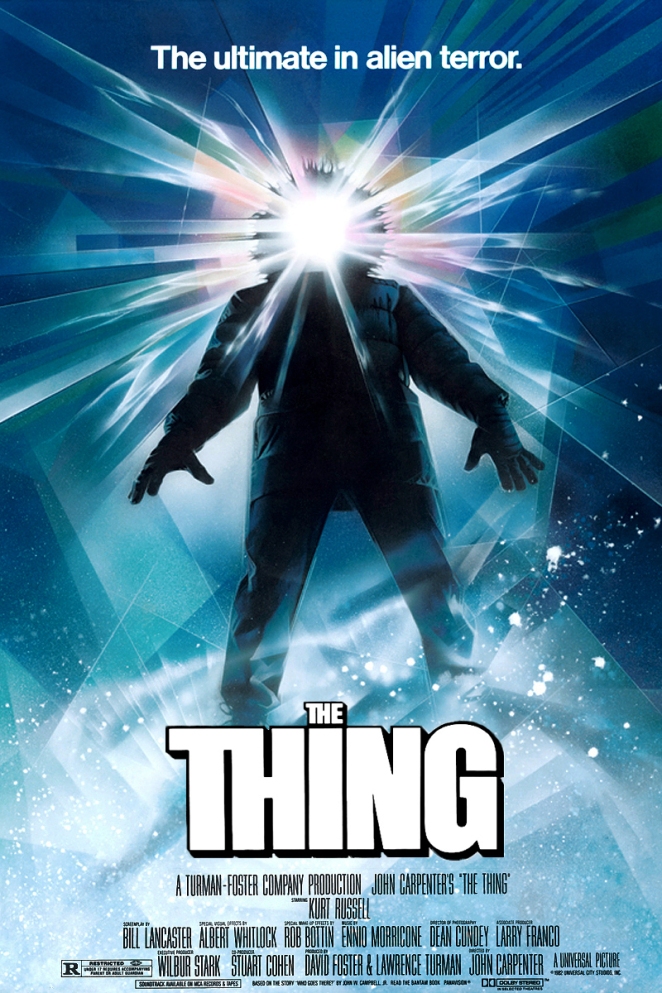
Directed by John Carpenter, The Thing (1982) follows a research team in Antarctica as they attempt to survive against a shape-shifting alien that consumes entire organisms into its form taking on their physical appearance. It was based on the novella, Who Goes There? by John W. Campbell Jr. The research team consists of the helicopter pilot, R. J. MacReady, played by Kurt Russell; the station physician Dr. Copper, played by Richard Dysart; senior biologist, Blair, played by Wilford Brimley; assistant biologist, Fuchs, portrayed by Joel Polis; geologist, Vance Norris, played by Charles Hallahan; meteorologist, George Bennings, portrayed by Peter Maloney; radio operator, Windows, played by Thomas Waites; mechanic, Childs, played by Keith David; assistant mechanic, Palmer, portrayed by David Clennon; dog handler, Clark, played by Richard Masure; and the cook, Nauls, portrayed by T.K. Carter.
The film starts with a Norwegian helicopter pursuing a sled dog. The pilot and helicopter blow up accidentally, leaving behind the sled dog at the US Outpost. Disturbed by these events, MacReady and Dr. Copper investigate the Norwegian base and recover charred malformed humanoid remains. The sled dog is put in the kennel with the other dogs and the Thing properly introduces itself by transforming and consuming the sled dogs. This begins the fight against the Thing! The team discovers a buried alien spacecraft that Norris theorizes has been buried for at least 100,000 years.
As they encounter the Thing in different forms, the team discovers that it assimilates with a person, ultimately becoming that person in Thing form. This is when things take a turn. Now, anyone in the crew could be a Thing and so suspicious run rampant. One by one, members of the crew fall prey to the Thing. We see almost every character meet their end by their deadly encounter with the Thing. There is the iconic defibrillator scene in which Copper attempts to defibrillate Thing-Norris, but instead, Norris’ chest becomes a giant mouth that bites off Copper’s arms. This scene demonstrates the impeccable practical effects this movie employs thanks to Rob Bottin.
The crew realizes the dangers to humanity if this organism escapes, so Blair kills all of the sled dogs and destroys their helicopter and radio. With all of the unrelenting paranoia, no one can trust anyone and tensions run very high. One by one, they drop like flies. MacReady figures out that each Thing is independent and devises a test using blood samples and a hot wire, which reveals Palmer to be a Thing. Each Thing can only be destroyed using fire, leading to a lot of charred remains.
Once the Thing is effectively assimilated, the only way for survival is to destroy the power generator and go back into deep freeze until humans come and unearth the deadly remains just as the Norwegians did. The last of the research team attempts to use explosives to destroy the base, fighting against Blair-Thing. Finally, only two remain, MacReady and Childs. They share a bottle of scotch as they wait to freeze to death. Leaving some major questions: what will happen when the recovery team comes in the spring? Is Childs actually a Thing? Is MacReady? Are they both or one of them? It is this ambiguity and the practical effects that have made this film such a cult classic.
Horror Film Rating System
| Category | Rating (/10) |
| Performance | 8 |
| Special Effects | 9 |
| Violence/Gore | 8 |
| Score/Foley | 8 |
| Scare Factor | 9 |
Performance
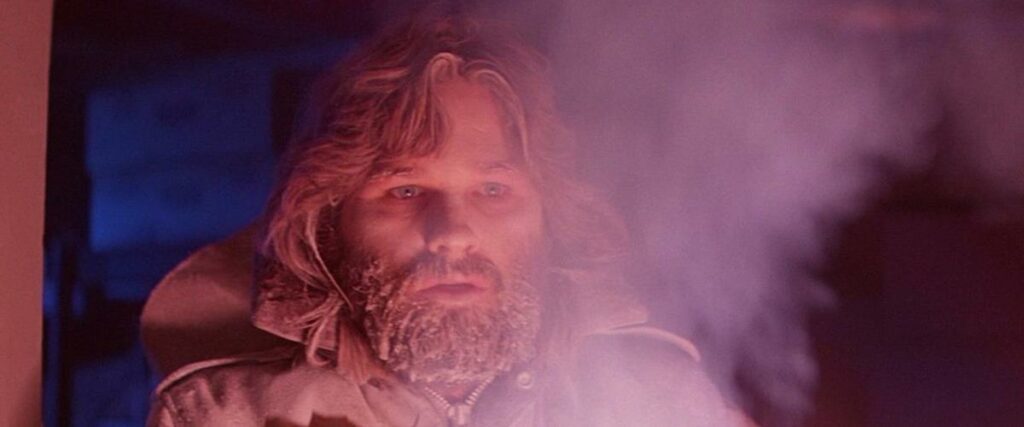
The performances in this film truly enhance the mood of the film, especially the paranoia the crew demonstrates for each other. Kurt Russell leads this film with his dashing good looks and dramatic performance. He gives quite a few speeches and is the one to conduct the blood test. I really enjoyed the scenes where every character was arguing with each other, adding to the paranoia and mistrust. Each actor fully commits to their role whether it is as their character or their Thing-Character.
Special Effects
The special effects in this film are incredible, especially for its time. I would argue that even today these effects hold up quite well. Rob Bottin is the main reason this movie is so memorable and a cult classic. This was his star-making role as special effects artist that fans will always love and remember. Apparently, he worked on this movie 7 days a week, slept in the studio, and was briefly hospitalized due to exhaustion. He is a dedicated artist that helped to create a film that has become a cult favourite due to the believable special effects. If you are interested in learning more about how they did the practical effects, this article is fascinating.
In a TV Tropes article, the author stated, “The visceral depictions of the anatomically creative forms the lifeform adopts when attacking or threatened were milestone achievements in both Special Effects rigging and creature design thanks to a fusion of masterful puppetry, makeup, and advanced FX rigging, bolstered by new green-screen effects like high-end claymation, matte painting, and early CGI. By using each for the tasks it did best, and combining several approaches in a single shot to create seamless composite effects, Carpenter left surprisingly little room for Narm to set in, and created one of the first cinematic environments to believably pull off Daylight Horror sequences.” In the video below, a comparison is made between The Thing (1982) and The Thing (2011). The main issue with the 2011 film is the over-reliance of CGI that leads to a decline in quality and believability as the movie ages and CGI technology improves. Where the 1982 film excels, the 2011 film falls flat and unbelievable. The saddest part of all? The 2011 film had originally used as many practical effects as possible, but then the production companies insisted on going over everything with CGI instead. Feel free to watch the video below for examples of the effects in both movies.
Violence/Gore
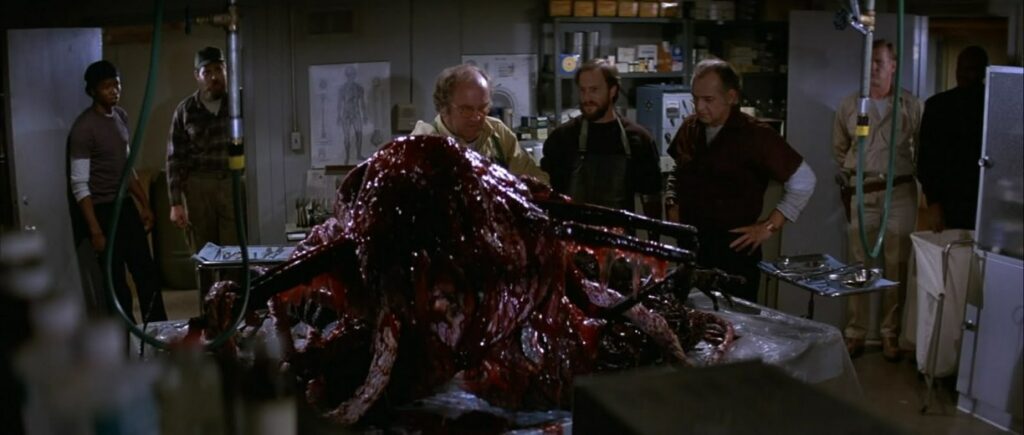
The Thing is a fantastic example of a creature feature in which the creature is alien in origin. This article goes into more depth about creature features you are interested in. There is no shortage of violence and gore in this movie as the Things kill, absorb and then are ultimately burned by the survivors. Once the Thing-Dog transforms and attacks the dogs, the real gore of the movie begins and then it escalates as the Thing continues to take over different organisms and the crew continues to use a flamethrower to destroy them. This leads to graphic scenes, such as the defibrillator scene, and the Bennings failed assimilation scene. Basically, the entire movie goes from one gory scene to the next. The one thing I will say is that although the practical effects are brilliant they do have a look of something not quite human, but something else. However, the creatures are still terrifying and disgusting, such as the weird spider-like head.
Score/Foley
The score and foley in this film also help to create the atmosphere and mood. As the paranoia among the crew escalates, so does the score with high-pitched sounds and escalating music. As well, the foley is fantastic, especially in the Thing scenes as there is plenty of squelching, cracking, slithering and other yucky sounds. Another aspect of the foley that I found to add to the film was the very loud dog howling, which sent my dog into defender mode! Finally, the score helps to foreshadow what is to come, especially with the Thing-Dog and its malevolent intentions. I really found that score and foley elevated the film making it a lot scarier.
Scare Factor
This was my first time watching this movie and I have to say I was quite impressed with the scares in this film. At points, I was frozen in place with my hands over my mouth. What makes this film so scary is the idea of not knowing who is human and who is Thing. As well, the setting of the film also adds to the scare factor. It is a desolate, excluded location (very similar to The Shining!) in which the crew spreads out, leaving lots of places to hide or to get attacked. The isolation and paranoia together create tension and fear for the viewer. Another technique used involves jump scares as lights turn on and off, which is a typical trope in the horror genre, but I would argue this is one of the earlier versions. It is infrequent enough that this still ends up being an effective technique unlike modern horror films that solely rely on jump scares (e.g. Paranormal Activity, The Conjuring series, Insidious sequels, Drag Me To Hell). A final aspect of this movie that adds to the scare factor is the ambiguity of the ending, leading to the viewers questioning what will happen next…
I would greatly recommend this movie as it is a cult classic that definitely had me on my toes the whole time. Thanks for reading!
Leave a Reply
You must be logged in to post a comment.