This post contains content not suitable for children. It contains discussion about violence, gore, death and cannabilism.
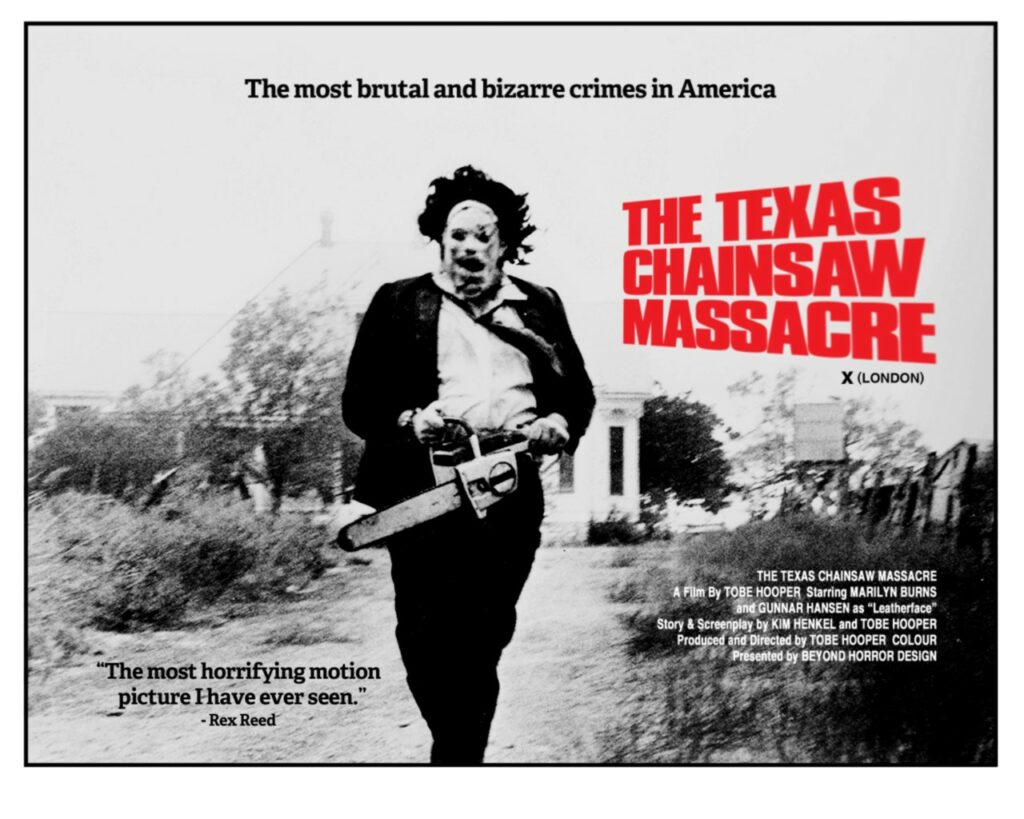
The Texas Chain Saw Massacre (1974), produced and directed by Tobe Hooper with the screenplay by Hooper and Kim Henkel, follows a group of friends who stumble upon a family of cannibals while they visit an old homestead. This film stars Marilyn Burns, Paul A. Partain, Edwin Neal, Jim Siedow and Gunnar Hansen, who respectively portray Sally Hardesty, Franklin Hardesty, the hitchhiker, the proprietor, and Leatherface. Hooper described the story as “a post-’60s version of Hansel and Gretel: lost but blindly optimistic young people wandering into strange places that gobble them up.”
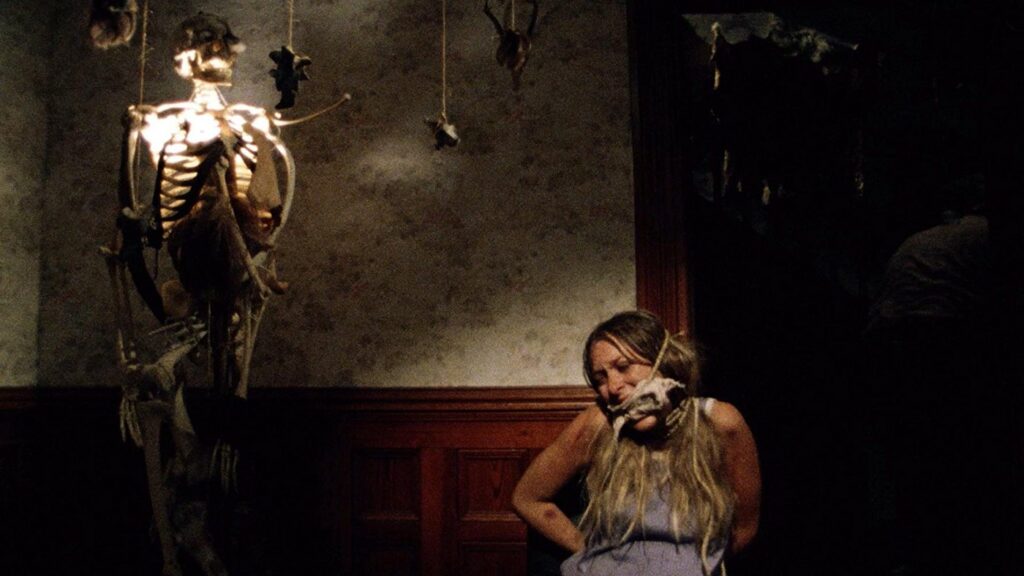
The film was marketed as based on true events as a ploy to garner more attention. However, it was loosely based on the crimes of Ed Gein, who fashioned trophies and keepsakes from his victims’ bodies. His house was filled with furniture made from human skin and bones, which is heavily featured in this film. Gein also created masks from the facial skins of his female victims, which is the inspiration for Leatherface’s ‘leather face’.
“People are absolutely convinced that it did happen,” says Gunnar Hansen, who starred as Leatherface and wrote a book in 2013, Chain Saw Confidential, aimed at separating the film’s facts from fiction. “Most people are surprised and don’t know whether to believe it or not, but there are some who actually get angry when I say, ‘No, it didn’t happen.'” (taken from Esquire article.)
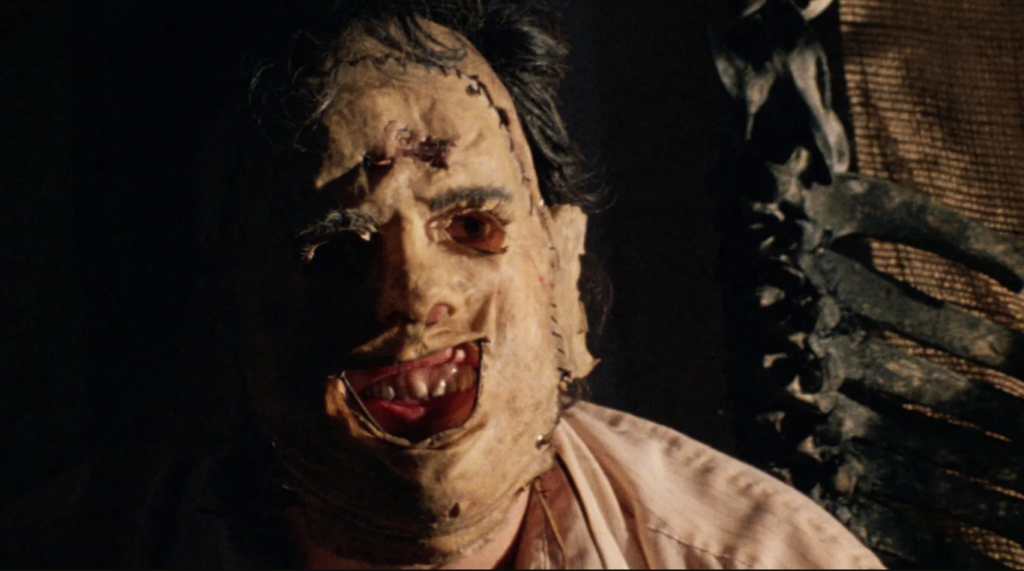
This film was pivotal for the slasher genre. It established several elements common in the slasher genre today, including the use of power tools as murder weapons, the characterization of the killer as a large, hulking, masked figure, and the killing of victims. The film was produced with a relatively small budget, a cast of unknown actors, and filming in Texas involved long hours seven days a week in incredibly hot temperatures. Despite all of this, Texas Chain Saw Massacre became a cult classic and one of the best and most influential horror films.
Horror Film Rating System
| Category | Rating (/10) |
| Performance | 9 |
| Special Effects | 4 |
| Violence/Gore | 8 |
| Score/Foley | 7 |
| Scare Factor | 10 |
Performance:
The performances in this film can be at times goofy representations of the 70s, but ultimately when the action occurs these actors show us the visceral reactions of fear humans experience and the psychosis and mental degeneration of the cannibalistic family.
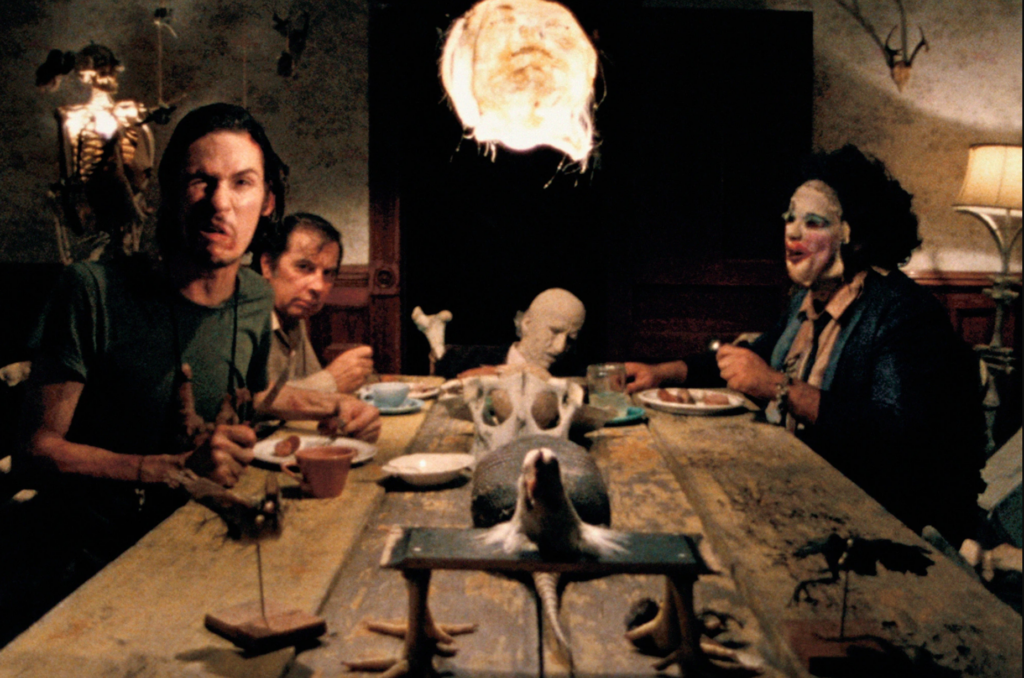
In particular, Gunnar Hansen (Leatherface) took his role incredibly seriously. He viewed his character as ‘mentally challenged’ and researched the character by spending time at a school for disabled children where his mother worked. He studied their body movements, watching how they walked, stooped and their erratic motions. I am always very nervous about neurotypical people portraying and I think today this portrayal would not be accepted. As well, I believe this stereotype of the mentally disabled killer in popular culture creates a hostile social climate for disabled people. However, for the time, Leatherface is a terrifying and believable character and Gunnar Hansen played his part very well, leading to a whole franchise based on Leatherface.
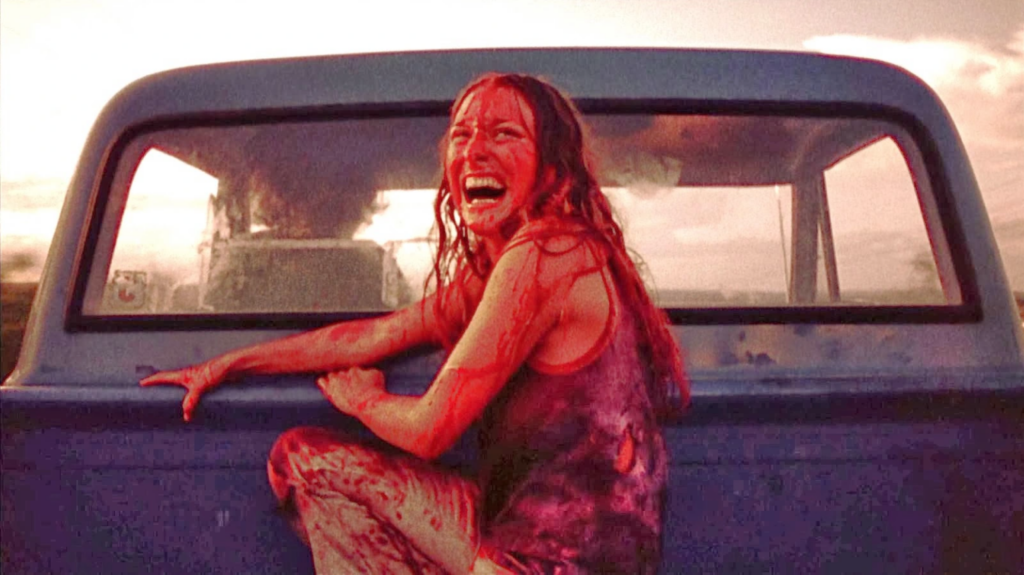
Another incredible performance was from Marilyn Burns, who played Sally Hardesty. Her character falls into the trope of the final girl as she is the only person to survive the ordeal. With that in mind, we spend the most time with Sally, showcasing Burns’ acting skills. In particular, the fear and terror she demonstrated throughout the torturous last half of the film. It should be mentioned that during some of the scenes, the other actors were physically hitting her, leaving her heavily bruised. She consented to this, but it is quite shocking. When they finished filming the scene, she fainted immediately. I think her tenacity and courageousness caused the audience to root for her character to make it out alive.
Special Effects:
Due to the tiny budget, the special effects are mostly simple or achieved through simpler techniques. Along with the budget, Hooper was determined to get a PG rating for this film, “so there’s no nudity, very little profanity, and contrary to what most people who’ve seen the film may recall, relatively little blood and gore.” (from The Dissolve). He was obviously unsuccessful as it was rated R.
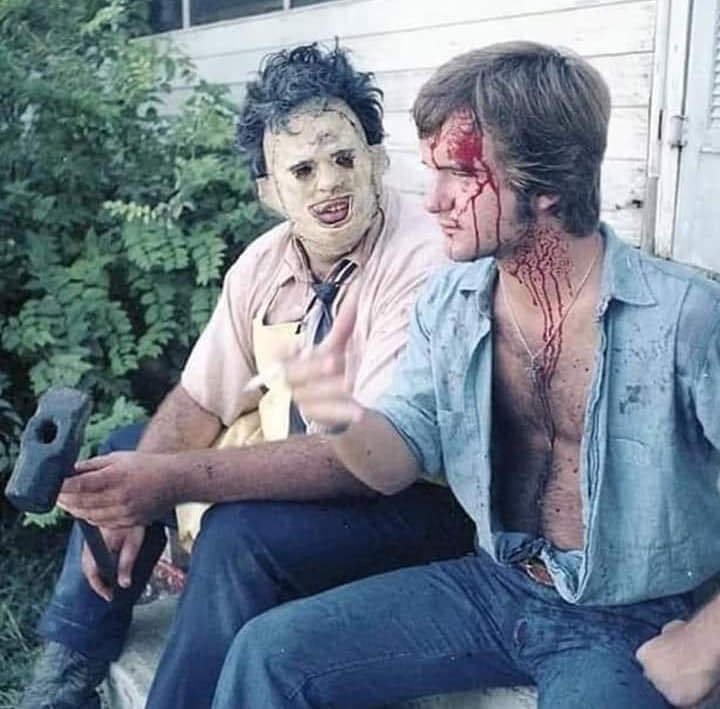
From an article by Ryan Lambie, “Some of the key sequences in Texas Chainsaw are created through simple filmmaking techniques rather than special effects: the moment when William Vail’s character is attacked by Leatherface is achieved through the toe-curling sound – the thud and sickening squelch of the hammer hitting a human skull – some great physical acting (Vail twitching his legs as he lies on the floor, Gunnar Hansen throwing the actor into a room off-screen), and finally, the final wrench of a metal door blocking the scene from view.”
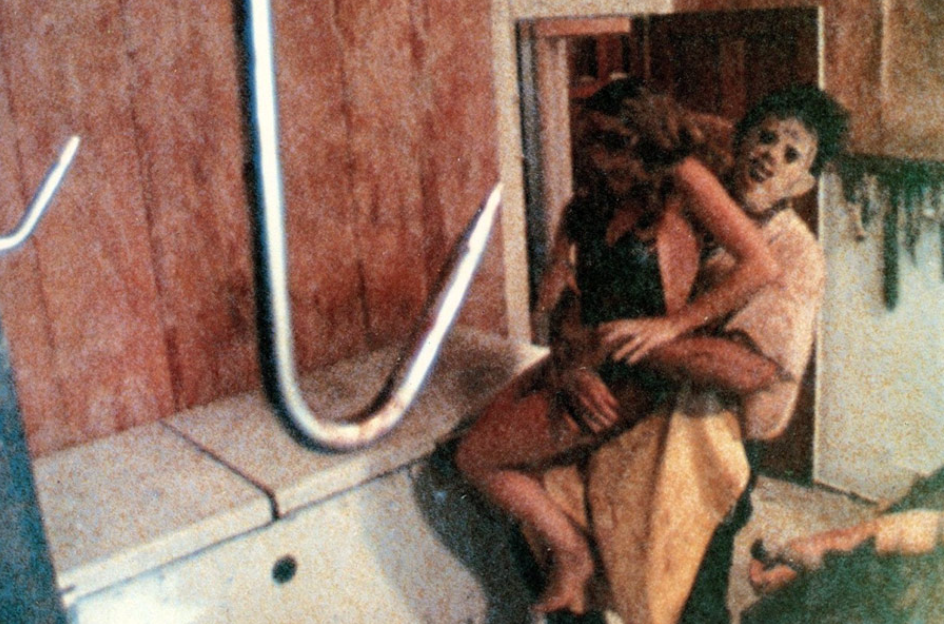
“The similarly terrifying moment where Leatherface lifts the screaming Pam (Teri McMinn) into the air and mounts her on a meathook is another example of filmmaking ingenuity winning out over effects. Hooper had initially thought about having the hook exit a prosthetic neck, with an accompanying geyser of blood. The lack of budget – and Hooper’s ill-fated desire to get the film a PG-rating – quickly nixed that idea. Instead, McMinn was hung on a simple and very uncomfortable saddle. The screaming and Pearl’s low camera angle effortlessly sell the scene’s horror. “
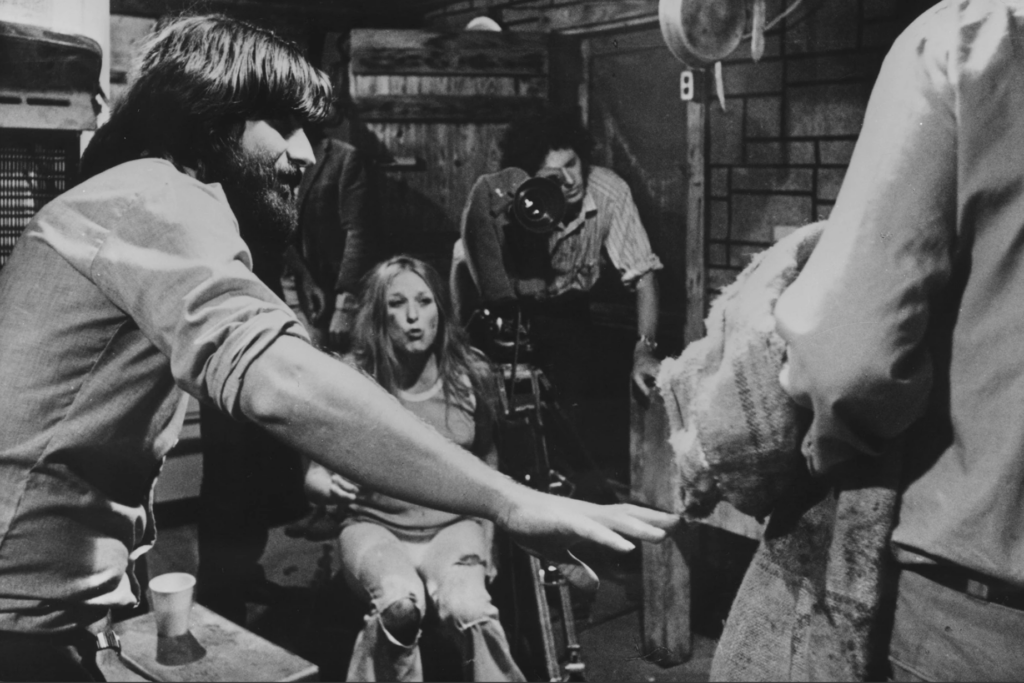
In one scene where the catatonic “grandfather” feeds on Sally’s blood, the special effect malfunctioned, Marilyn Burns was actually cut and her blood actually sucked by the other actor, John Dugan. Some of the stunts as well were actually performed on the actors. Overall, the special effects were fine in this movie, but are not what makes it so good. It was Hooper’s vision and eccentricities that made it so memorable.
Violence/Gore:
“One of the most amazing tricks in filmmaking in the [horror] genre is the fact that when you really look at the movie, you realize there is almost no blood or graphic violence onscreen,” Alexandre Aja says. “It’s the editing, the rawness, the craziness of what you see that makes the experience so intense. Your mind creates what you don’t see in the movie and fills in the gaps to see all the ‘massacre’ that Hooper doesn’t actually show onscreen.” (taken from Esquire article.)
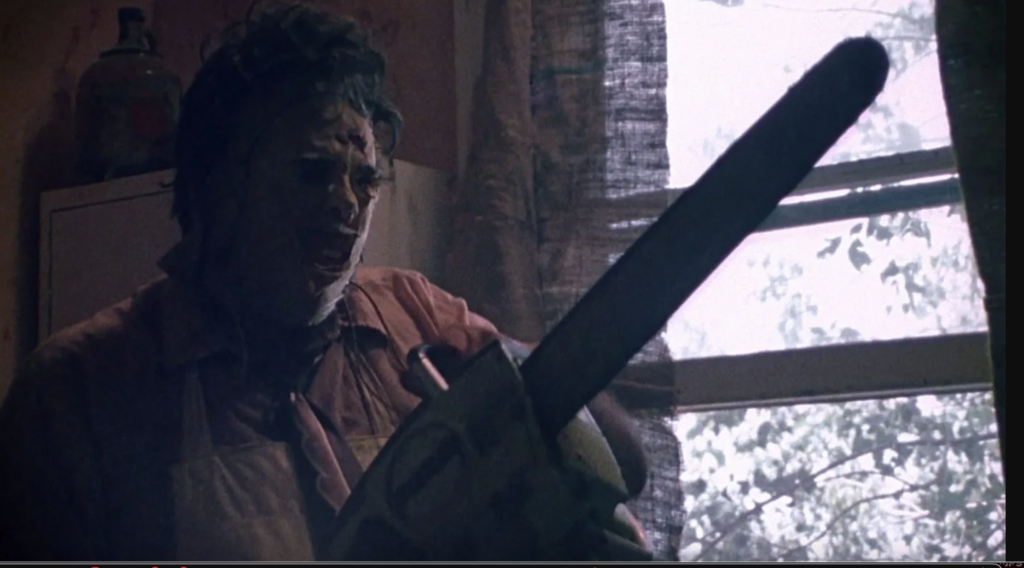
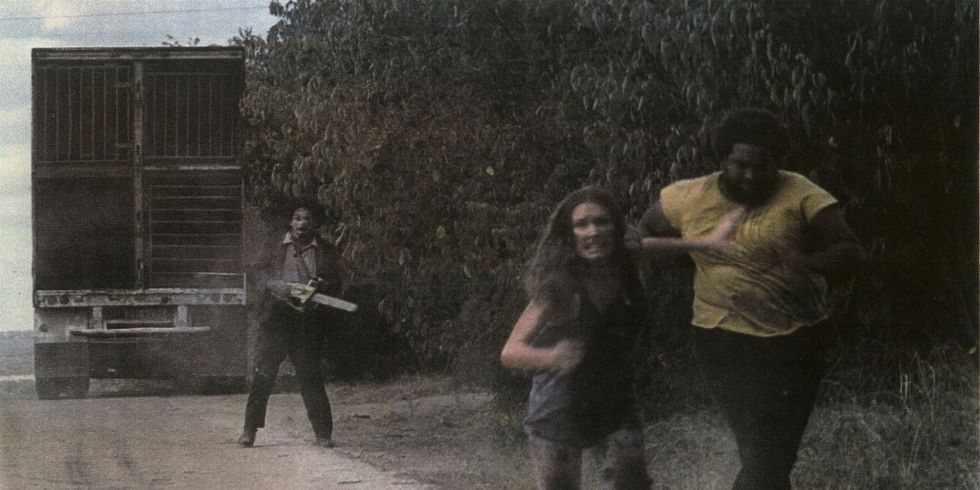
With Hooper’s unattainable dream of a PG-rating, a good portion of the violence is implied, but not shown. For me, what was really disturbing was seeing all of the set decoration in the house: the chairs made from bones, skin lamps, skulls… The implication is that these body parts are from their victims (however many there maybe). Another aspect of the violence in this film stems from the character of Leatherface. He is wearing a victim’s face as a mask and he moves so quickly and strongly as he attacks his victims. The iconic scene of him wielding his chainsaw wildly around on the road lives on in the annals of horror film history.
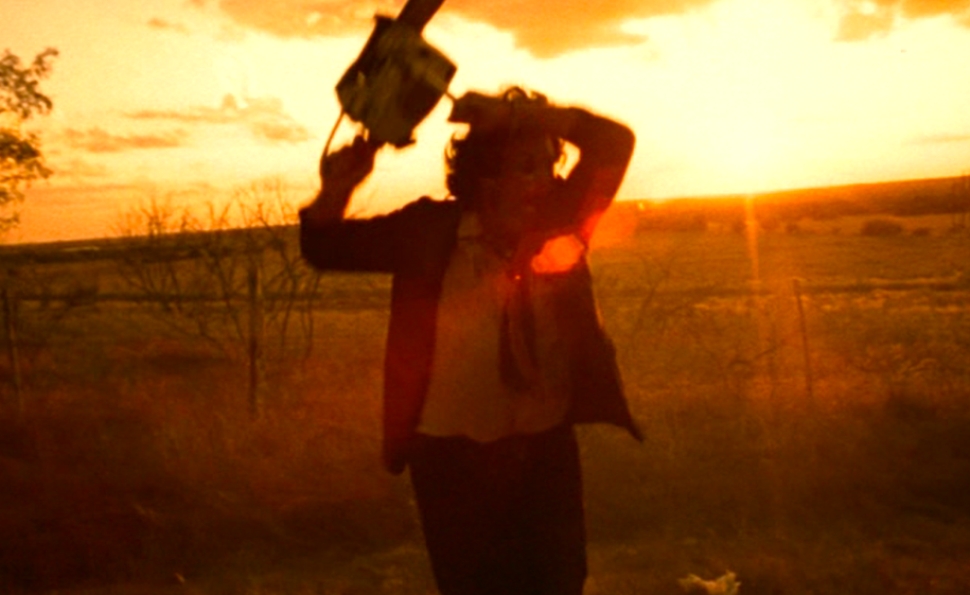
The atmosphere created through the pacing, performance, and overall sweatiness even the audience can experience adds to the feelings of fear. Add in this terrifying family and their violent ways. It becomes a terrifying and violent movie, just with less gore than it could have had. Part of what makes it so violent is the idea that this family has been killing and eating people for a very long time.
Score/Foley:
The score and foley in this film are incredible because of how disconcerting it is for the audience. At points, they use happy ‘hippy’ songs for the calmer and happier moments, which then adds incredible contrast when the attacks occur and the score becomes this chaotic jumble of horrible sounds. From Ryan Lambie, “The director couldn’t afford to commission an expensive soundtrack, so he and Wayne Bell made it themselves – a nerve-jangling cacophony of exotic instruments and unearthly noises and screams.” Overall, the score and foley in this film convey the mood of the film and add to the scare factor for the audience. The score is as unsettling as the violence depicted.
Scare Factor:
I feel that this film is one of the best horror films. The scare factor is very high because of the shaky shots, wild angles, terrifying script, and characters. There are multiple jump scares when Leatherface pops out on his unsuspecting victims. Normally, I find jump scares to be unnecessary or poorly done, but in this film, these jump scares are genuinely scary and not overdone. At the beginning of the film, this group of idyllic twenty-somethings encounters multiple creepy townsfolk, who then foreshadow what is to come. They insist that this group shouldn’t bother to stop and just keep going. This foreshadowing adds to the scare factor as it hints to the audience that bad things are to come.
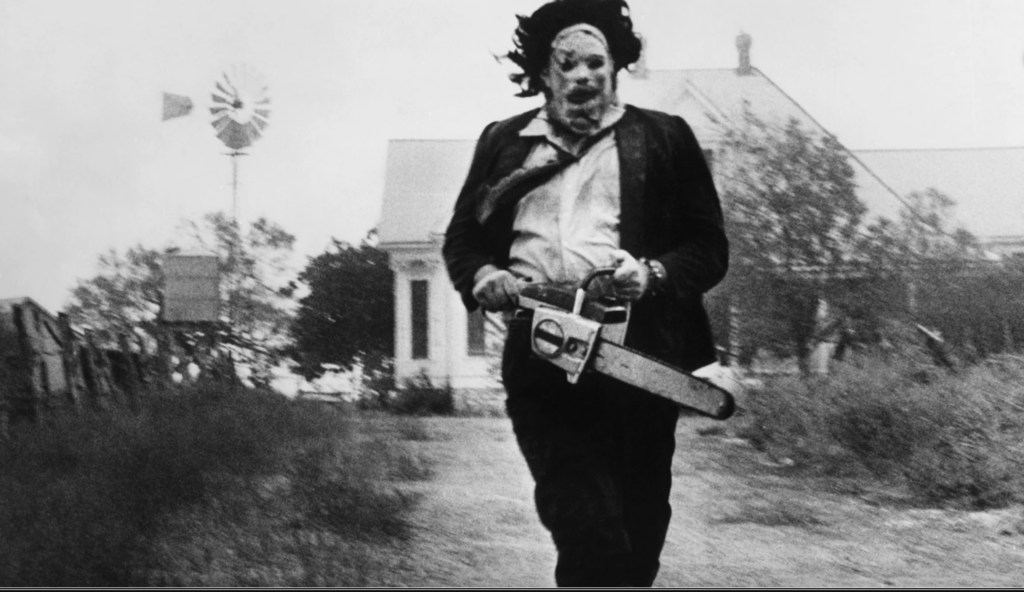
All of the imagery of body parts from animals and humans are horrifying, adding to the scare factor. I would certainly react the same way as these characters when they enter this horrific house. I think too knowing it’s based on Ed Gein and his house actually did look like this makes my skin crawl more. Sally’s entire journey through this traumatic experience made the audience root for her, while Leatherface and his family are the terrifying villains to be feared. The scare factor of this film is 10/10 as it is a horrifying film that hits on our most primal fears.
Leave a Reply
You must be logged in to post a comment.